Prompting or Scripting ?
Posted on February 13, 2026
-
Preambule
This article deals with the use of prompts when the results are numerical data, it does not emit opinion or fact on applications such as :
- Chatbots for marketing or support
- Translation tools.
- Social, medical, … applications
The only certitude for these applications is that the cost in energy is high
and nobody knows where it is going. Each time you send data to them, they will process , store it,
leading to more need in energy,...
It gives the feeling that cost is low, but it is always the same approach : it is free to
gain users, you pay later when you are captive.
-
Security
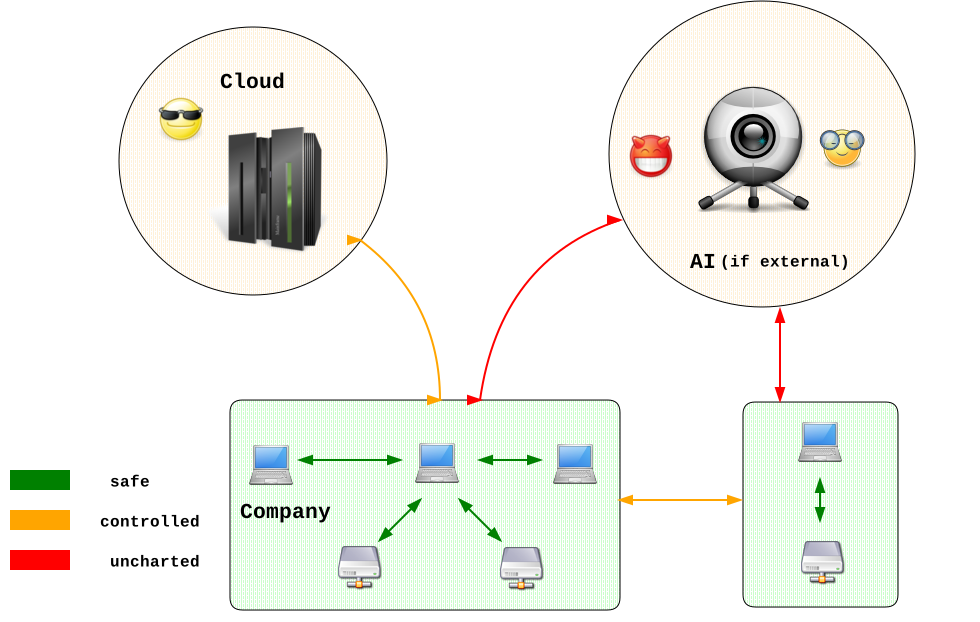
When you are using prompt you are sending informations to server that will also
take what it needs without any warning. Once the set of prompts has lead to a satisfying solution,
anyone can reproduce what you have found.
If the AI you are using is on the premises, it does not matter, else, you will find soon a competitor
on the market : a set of prompts is easy to reproduce.
Scripting is different. The different steps are unitary defined with known parameters and known
algorithms. They can run on premises or in the cloud. If they run in the cloud, it is always
on servers from engineering firms : Ansys, Dassault, Siemens ... that know to manage customer's data.
Concerning cybersecurity, Artificial Intelligence is in its infancy and small firms should not take
a risk in it because obsolescence will run fast and will be costly.
-
Innovation
Engineers worlwide, have the same level of knowledge, especially the young engineers.
Only the organizations around them make them more or less efficient with
motivation and know-how.
But what if your new supply electronical card has been developped with only prompts ?
Engineers have the same level of anticipation and concerns leading to the same approach
… and the same prompts … you have lost your advance …
By chance in advanced technologies, the competition is fair because it is so complex,
that reproducing it with only prompts is still impossible.
Scripting is a more crafted approach. It is elaborated with the know-how of your company
and stay inside.
If the AI you are using is on the premises, it does not matter, else, you will find soon a competitor
on the market.
Scripting is different. The different steps are unitary defined with known parameters and known
algorithms. They can run on premises or in the cloud. If they run in the cloud, it is always
on servers from engineering firms : Ansys, Dassault, Siemens ... that know to manage customer's data.
Concerning cybersecurity, Artificial Intelligence is in its infancy and small firms should not take
a risk in it because obsolescence will run fast and will be costly.
-
Accuracy and robustness
Although you can see nearly everywhere AI associated with new
release of technical softwares, the pilar of designing is still base on
classical methods. Most often design of experiments is used to start everything.
Then, AI is trained with the generation of models originating from the previous
designs.
It is difficult to say if the design is accurate or robust. The only way is to simulate
them again with known differences. Which in CAD for complex shapes is a difficult task.
AI will probably not replaced experimented designers because AI will not invent something,
it will give the best solution among hundreds, even thousands, but will discover nothing.
As scripting is base on certainty and experience there is a better chance to be robust
and more accurate but you are not sure it can be the best solution.
-
Cost
Let us suppose that the design developped with, and without AI are similar.
The immediate differences are in the time used to get to the supposed best design,
the cost of new subscription and new hardware. It is worth the matter if your team
of engineers can work on new projects or if you need less engineers (this is the dark side).
It we compare to the scenarii blueprint → CAD or washerwoman → washing machine, the changes
were brought by the production benefits made with the other firm products or even external investments;
they were not so huge as they are today in AI. The cost to buy software licences and hardware,
or to buy a washing machine were important but clearly went to the creators of the innovation.
Then the pace of improvement was bearable because it was relatively slow with small rising price.
With AI, there is the final user, the software or machine vendors and the now AI providers that
has invested hundreds of billions of euros. And probably more is to come. It is so abrupt that
prediction on ROI is still vague.
Now for EDA, CAD or CAE there are standard and there is no monopoly. Changing of software supplier
is not easy but not impossible. But changing from OpenAI to Anthropic or Mistral to Deepseek
will have an undetermined cost because you have to generate data again from zero, and previous prompts
are obsolete.
-
Conclusion : Script, do not prompt !
In the essay "Scripting : Higher-Level Programming for the 21st Century" in 1998,
John Ousterhout show the advantages of script languages. There is in particular a comparison
between the different programming languages :
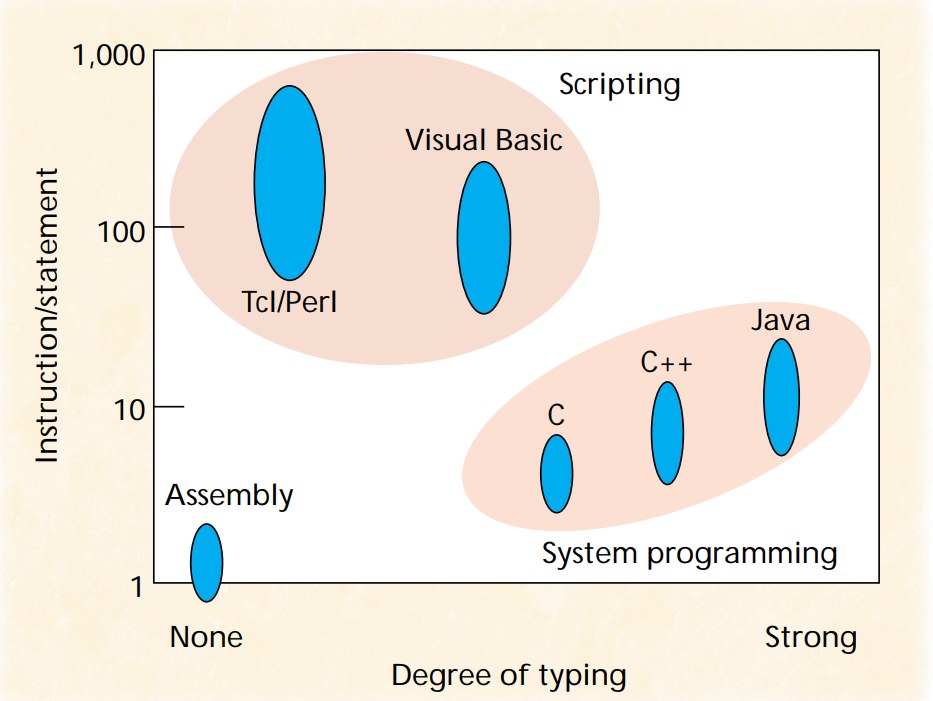
In this perspective, productivity can be measured by comparing the time spent to create scripts and time spent to design the same functionality with system programming languages. In a few set of examples, the ratio went from about 10 to 100.
In the same approach, the productivity of AI could be measured by using it to make new functionalities coded in script language. The advantage of this determinist solution is that AI becomes reproductible through the intermediary of scripts. It is also very cost effective and sustainable because the script language interfacing with your favourite engineering software better handles configurations than AI.
AI seems a new passage because it is fast and is very useful when data seem not to be organized, but in the long run, will it be recognized as a mystification because nobody knows what it is really able to do while its stakeholders want to apply it on anything ? And what will be the costs ? The cost of energy, the cost of being captive the cost of lost know-how, the cost of undermined motivation ... The devil is in the details, and AI cannot be totally trust because it is based on reliability.